

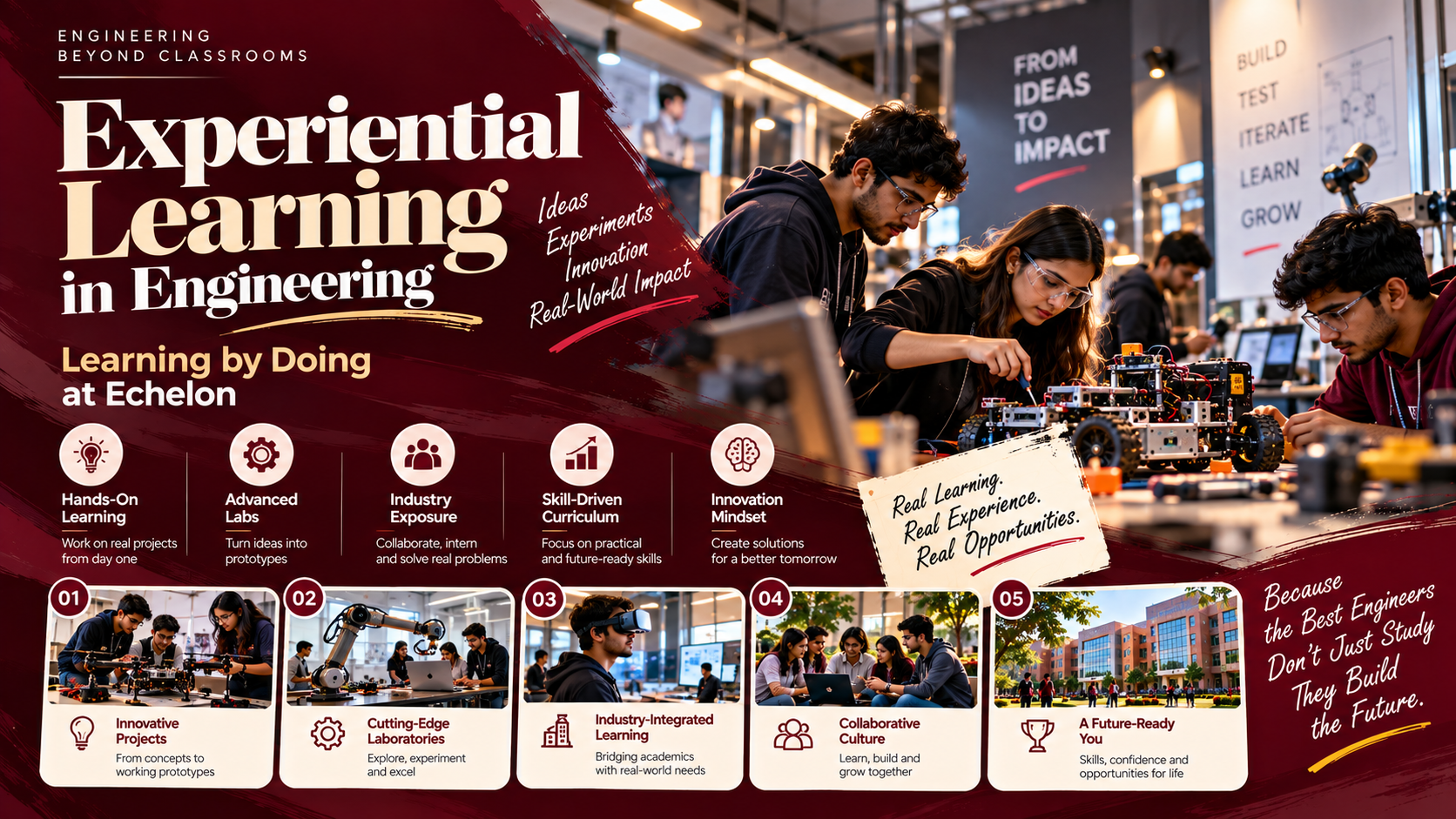
Experiential Learning in Engineering | Learning by Doing at Echelon
On this page
- What Is Experiential Learning?
- What Is Learning by Doing?
- Programming
- Robotics
- Engineering Labs
- Why Is Experiential Learning Important in Engineering?
- Problem Solving
- Technical Skills
- Innovation
- Teamwork
- Career Skills
- Confidence
- Experiential Learning vs Traditional Learning
- What Is Holistic Education?
- Holistic Education = More Than Academics
- Experiential Learning at Echelon Institute of Technology
- How Does Learning by Doing Work at an Engineering College?
- Practical Learning Through Engineering Labs
- Learning by Doing Through Engineering Projects
- AI & Machine Learning
- Robotics
- IoT
- Experiential Learning Through Industry Exposure
- Why Are Internships Important for Experiential Learning?
- Academic Learning → Internship → Real-World Experience
- Experiential Learning Through Hackathons and Technical Activities
- How Does Holistic Education Help Engineering Students?
- Technical Growth
- Leadership
- Innovation
- Experiential Learning in Delhi NCR
- How to Choose a College for Experiential Learning?
- Frequently Asked Questions About Experiential Learning
- What is experiential learning?
- What is learning by doing?
- Why is experiential learning important in engineering?
- What is holistic education?
- Is learning by doing useful for engineering students?
- Does Echelon Institute of Technology follow experiential education?
- Does Echelon focus on holistic development?
- What is practical learning in engineering?
- What is industry-oriented education?
- Explore Experiential Engineering Education at Echelon
- Explore More Echelon & GGSIPU Guides
- About Echelon Institute of Technology
Experiential Learning in Engineering: Learning by Doing & Holistic Education
Discover how experiential learning, learning by doing and holistic education can help engineering students develop practical skills, problem-solving abilities, creativity and industry readiness.
What Is Experiential Learning?
Experiential learning is an education approach in which students learn by applying knowledge through practical activities, projects, experiments, internships, industry exposure and real-world problem solving.
In engineering education, experiential learning connects classroom concepts with practical application. Instead of only studying how something works, students get opportunities to build, test, analyse and improve solutions.
Topics covered in this guide:
Experiential Learning Learning by Doing Holistic Education Holistic Learning Practical Learning Industry-Oriented Education Engineering Education Experiential Education
What Is Learning by Doing?
Learning by doing means developing knowledge and skills by actively performing tasks, conducting experiments, developing projects and solving practical problems.
For engineering students, learning by doing can transform theoretical concepts into practical experience.
Programming
Learn programming concepts and apply them by developing software, applications or technical solutions.
Robotics
Study robotics concepts and apply them through robot design, programming, sensors and automation projects.
Engineering Labs
Apply classroom concepts through experiments, simulations, testing and practical laboratory work.
Why Is Experiential Learning Important in Engineering?
Engineering is an application-oriented field. Students eventually need to use theoretical knowledge to solve real-world problems. Experiential learning creates opportunities to develop both technical and professional skills.
Problem Solving
Students learn to identify problems, analyse possible solutions and test their ideas.
Technical Skills
Practical projects provide opportunities to use engineering tools, software, hardware and laboratory equipment.
Innovation
Students can turn concepts into prototypes, applications and innovative solutions.
Teamwork
Collaborative projects help students develop communication, coordination and leadership skills.
Career Skills
Projects, internships and industry interactions can help students understand professional expectations.
Confidence
Practical experience can help students become more confident when applying their knowledge to unfamiliar problems.
Experiential Learning vs Traditional Learning
Traditional Learning | Experiential Learning |
|---|---|
Primarily classroom based | Classroom + practical application |
Focus on theoretical concepts | Theory combined with experience |
Textbook-based problems | Real-world problems and projects |
Assignments and examinations | Projects, experiments and practical activities |
Teacher-led learning | Active student participation |
Knowledge acquisition | Knowledge + application + skills |
What Is Holistic Education?
Holistic education focuses on the overall development of a student rather than academic knowledge alone.
In an engineering environment, holistic education can combine technical knowledge with communication, leadership, creativity, teamwork, ethics, entrepreneurship, social responsibility and professional development.
Holistic Education = More Than Academics
Technical knowledge
Practical skills
Critical thinking
Communication
Leadership
Creativity and innovation
Teamwork
Ethical and social awareness
Career development
Experiential Learning at Echelon Institute of Technology
Echelon Institute of Technology (EIT), Faridabad describes its academic approach around experiential and outcome-based education. The institute states that its objective is to develop practical skills, problem-solving abilities and leadership capabilities alongside academic learning.
EIT's current B.Tech information highlights hands-on technical training through advanced engineering laboratories, robotics and automation labs, embedded systems and IoT training, industry projects, internships, hackathons and innovation competitions.
Learn more about Echelon's educational approach →
How Does Learning by Doing Work at an Engineering College?
01 Learn
Understand the fundamental concept.
02 Apply
Use the concept in practical activities.
03 Build
Create a project or prototype.
04 Test
Evaluate and improve the solution.
05 Present
Communicate the final solution.
Practical Learning Through Engineering Labs
Engineering laboratories provide students with an environment where theoretical concepts can be tested through experiments and projects.
Echelon's current engineering information highlights advanced engineering laboratories, industry-integrated labs, robotics and automation facilities, embedded systems and IoT training.
Artificial Intelligence and Machine Learning
Robotics and Automation
Internet of Things
Embedded Systems
Cloud Computing
Cybersecurity
Electronics and Communication
Mechanical Engineering
Learning by Doing Through Engineering Projects
Projects can help students move from understanding a concept to actually implementing it.
AI & Machine Learning
Students can work on prediction, classification, computer vision and other AI applications.
Robotics
Students can explore robot design, sensors, programming, automation and intelligent systems.
IoT
Students can connect sensors, devices and software to create connected technology solutions.
Experiential Learning Through Industry Exposure
Industry exposure can help students understand how academic concepts are used in professional environments.
Industry expert lectures
Industrial visits
Internships
Industry projects
Technical workshops
Hackathons
Career-oriented training
Professional networking
Echelon's Industry Expert Lecture Series includes sessions covering areas such as Artificial Intelligence, Machine Learning, Cloud Computing, Cybersecurity, Blockchain and Data Science, along with interaction and networking opportunities.
Explore Echelon Industry Expert Lectures →
Why Are Internships Important for Experiential Learning?
An internship allows students to experience a professional environment and understand how technical knowledge is applied to real tasks.
Academic Learning → Internship → Real-World Experience
Through internships, students can gain exposure to workplace communication, professional tools, project execution, deadlines, teamwork and industry expectations.
Experiential Learning Through Hackathons and Technical Activities
Hackathons and technical competitions encourage students to solve problems, collaborate with peers and develop working solutions within a defined time.
Echelon's professional societies currently highlight technical bootcamps, hands-on training, hackathons, technical challenges, project expos, coding challenges, industrial visits and industry collaborations.
Explore Technical Activities at Echelon →
How Does Holistic Education Help Engineering Students?
Technical knowledge is important, but professional growth also involves communication, leadership, collaboration, creativity and responsible decision-making.
Echelon describes holistic development through areas including ethical values, leadership skills and social responsibility, alongside technical and academic development.
Technical Growth
Building knowledge and practical skills related to the student's engineering discipline.
Leadership
Developing the ability to collaborate, coordinate teams and take responsibility.
Innovation
Encouraging curiosity, experimentation and new approaches to engineering problems.
Experiential Learning in Delhi NCR
Students searching for experiential learning in Delhi NCR should compare colleges based on actual opportunities rather than relying only on marketing terminology.
Before selecting an engineering college, check whether students receive access to laboratories, real projects, internships, industry interaction, technical competitions and expert-led learning.
For students exploring engineering education around Delhi NCR, Echelon Institute of Technology, Faridabad is one institution that explicitly positions experiential and outcome-based education as part of its academic approach.
How to Choose a College for Experiential Learning?
Check the engineering curriculum.
Look for advanced and programme-specific laboratories.
Check project-based learning opportunities.
Review internship opportunities.
Look for industry interaction and expert sessions.
Check technical clubs and student activities.
Review hackathons and innovation programmes.
Understand placement and career-preparation support.
Compare faculty and mentoring systems.
Visit the campus and verify facilities before admission.
Frequently Asked Questions About Experiential Learning
What is experiential learning?
Experiential learning is learning through practical experience, projects, experiments, internships, industry exposure and real-world problem solving.
What is learning by doing?
Learning by doing means developing knowledge and skills by actively performing tasks, conducting experiments and creating practical solutions.
Why is experiential learning important in engineering?
It helps engineering students connect theoretical knowledge with practical applications while developing problem-solving, technical, communication and teamwork skills.
What is holistic education?
Holistic education focuses on the overall development of students, including academic knowledge, practical skills, communication, leadership, creativity, ethics and social responsibility.
Is learning by doing useful for engineering students?
Yes. Engineering students can use learning by doing to apply classroom concepts through laboratories, projects, prototypes, internships and technical activities.
Does Echelon Institute of Technology follow experiential education?
Yes. Echelon's current institutional information describes its approach as experiential and outcome-based education and highlights hands-on technical training, laboratories, industry projects, internships and hackathons.
Does Echelon focus on holistic development?
Echelon identifies holistic development as an educational priority and highlights areas including leadership, ethical values and social responsibility alongside technical education.
What is practical learning in engineering?
Practical learning means applying engineering concepts through laboratories, projects, experiments, prototypes, simulations, software tools and real-world applications.
What is industry-oriented education?
Industry-oriented education connects academic learning with professional requirements through industry projects, internships, expert sessions, workshops and practical training.
Explore Experiential Engineering Education at Echelon
Explore B.Tech programmes, practical learning opportunities, engineering labs, industry exposure and career-focused education at Echelon Institute of Technology, Faridabad.
Explore More Echelon & GGSIPU Guides
About Echelon Institute of Technology
Echelon Institute of Technology (EIT), Faridabad, was established in 2007 and is affiliated with Guru Gobind Singh Indraprastha University, Delhi and approved by AICTE. The institute describes its academic approach around experiential and outcome-based education, industry collaboration, practical learning and holistic development.
Disclaimer: This article is intended for educational and informational purposes. Programme details, facilities, admission rules and other institutional information can change. Students should verify the latest information directly with the relevant university and institution before making admission decisions.
Not sure which college is right for you?
Talk to a free counsellor — no cost, no obligation.